East of Eden Programme Notes
By Carmen Paddock
If you were looking at the library this summer for a copy of East of Eden, John Steinbeck’s family saga-stroke-California creation myth, you likely found yourself at the end of a 20-deep queue. The epic novel was in hot demand with the release of Netflix’s East of Eden miniseries in October, starring Florence Pugh and largely written by Zoe Kazan. Another Kazan, however, was the first to put the novel on a major screen in 1955. That was Zoe’s grandfather Elia, famed collaborator of both Tennessee Williams and HUAC. His life and legacy provide their own metatextual commentary on Steinbeck’s story of inheritance, human nature, and our power to choose our fate for better and worse.
When Elia Kazan began work on East of Eden, he had made a name for himself by directing films that delved into the personal and social issues of his day. “I don’t move unless I have some empathy with the basic theme,” he once said, addressing American antisemitism in Gentlemen’s Agreement (1947), American racism in Pinky (1949), American illusions of gentility and squeamishness around sexuality in A Streetcar Named Desire (1951), and American workplace corruption in On The Waterfront (1954). Fresh off that film’s twelve Oscar nominations and eight wins, including his own for Best Director, an American Biblical retelling was the logical next step.
In 1952, however, Kazan cast himself in the starring role of “friendly witness” before the House Un-American Activities Committee (HUAC). Here, he named names, blacklisting artists — some friends and colleagues — with accusations of communist activity as the Cold War ramped up. Many of their careers were effectively ended. Kazan justified himself by saying he was between a rock and a hard place as an immigrant and artist, that he and playwright Clifford Odets had agreed to name each other should the other be subpoenaed, that any decent man of conscience — like Marlon Brando’s Terry Malloy in On the Waterfront — would have done the same. His complicity in political censorship of US art and media is a thorny legacy (Orson Welles did not mince words when asked about Kazan in a 1982 Paris film school interview: “Elia Kazan is a traitor,” Orson Welles intoned, waxing eloquent about his moral bankruptcy before concluding with, “I have to add that he is a very good director”). When he won another honourary Oscar in 1999, there were protests outside and dozens of stony faces in the audience.
It is interesting, therefore, to examine East of Eden as the work of a man three years out from a monumental, and bad, decision. It forms the crux of Zoe Kazan’s only public comment on her grandfather’s legacy. This is a story about the power of choice and circumstance, with Biblical allegories aplenty (note the names of the central Trask family); while Steinbeck’s novel spans three generations, Kazan wisely chose to focus his runtime and resource limits on the last 200 pages and final generation (a great decision for both East of Eden newcomers and old hands: much of Steinbeck’s story will remain a surprise to those inspired to pick up the novel, and Kazan is able to remain largely faithful to his material within his two-hour runtime). There are no direct parallels to the “Red Scare” or subversive activity, but every character is obsessed with the idea of whether or not they are good, and whether or not that goodness can be cultivated from within. The thought that they might be doomed from the start and cursed with its absence by nature or nurture is enough to drive one mad. However, the option not to think of this, to carry on blithely, is shown to be an empty one.
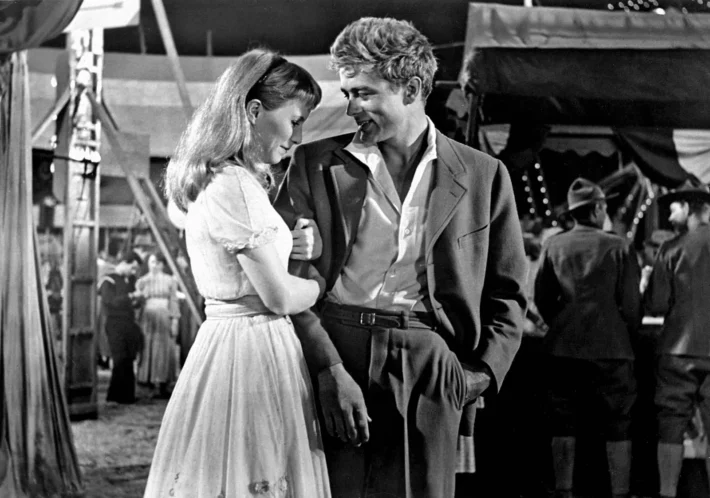
Therefore, Cal Trask (James Dean) becomes the antiheroic protagonist. The film opens with Cal stalking a mysterious veiled woman through the streets of Salinas, beautifully shot on location in the actual Salinas Valley and Mendocino County. Cal is clearly troubled, avoiding the woman while she is on the street but throwing rocks at the house she disappears inside. This avoidance and aggression come up again at home, as viewers meet his twin brother Aron and his father Adam. Kazan’s script expertly charts his growth from wayward son to burgeoning business associate to young lover to fully-formed man in his own right, while revealing the story of the woman he is desperate but terrified to know. But he remains a difficult figure to love. There is no neat coming-of-age path as Cal sabotages himself and his family; these actions read today as desperate cries for attention and we want to tell him to snap out of it, but they delve into the uncomfortable idea that blood ties, even those unknown, can never be overruled.
Cal is an excellent vehicle for Dean’s mercurial, instinctual talents — such that often worked against him on set and in life but produced true brilliance captured in Kazan’s lens. He received his first of two posthumous Oscar nominations for this tortured performance that teeters between youthful innocence and squandered, world-weary experience; indeed, East of Eden was Dean’s first feature film credit and the only such appearance released during his lifetime.
East of Eden is a landmark cinematic achievement regardless of Kazan’s reputation and off-screen choices; everything from the production design and costumes to the performances, hailing a virtuosic new age of naturalism in American cinema, is impeccable. However, it becomes something richer considering the complications of its creator. Kazan made his choice to put his day’s great sins on screen while committing his own in front of the House of Representatives. As today’s generations are seeped in a different kind of political and artistic furore and his granddaughter turns a new, skilled hand to a television adaptation, East of Eden continues to offer the next generation the same choice Elia Kazan and Cal Trask faced. It is up to us not to squander it.
Carmen Paddock is a Glasgow-based writer and editor whose work largely looks at cross-media adaptations across film, television, theatre, and literature. Her writing can be found in The Skinny, Little White Lies, Parterre Box, and VAN Magazine.